
Gldyql Meaning: What It Could Be and Why It Matters
The keyword “gldyql” looks like one of those internet terms that pops up with zero context, then suddenly shows up in searches, comments, app logs, or random posts. In most cases, strings like this are not “words” at all. They’re identifiers, abbreviations, typos, or generated text that spreads faster than anyone can define it.
What makes gldyql interesting is the uncertainty. When a term has no clear definition, people fill the gap with guesses, clickbait explanations, or misinformation. That matters because the meaning you accept can shape your next step, whether you ignore it, search it, or click something tied to it.
This guide breaks down what gldyql could realistically be, how to investigate it safely, and why these “mystery keywords” matter in digital life. We’ll stay practical, focus on patterns that show up again and again online, and help you avoid common traps.
What “gldyql” might mean in real-world digital context
On its face, gldyql doesn’t behave like a normal word. It has no obvious syllable pattern, no clear language roots, and no widely recognized definition. A quick check of major dictionaries turns up entries for “gladly”, but not “gldyql”, which suggests it’s likely not a standard vocabulary term.
A random string, handle, or autogenerated token
One common explanation is that gldyql is simply a generated string. It could be a username, a short code from an app, a tracking parameter, a temporary file label, or a system-generated identifier. These strings get copied and shared, especially when someone screenshots a screen error or posts logs without understanding what they’re seeing.
A typo or “near miss” of another known term
Another possibility is that gldyql is a typo, misread text, or keyboard slip. It’s visually close to “gladly” if letters were rearranged or mis-typed. It can also be confused with other tech abbreviations that look similar at a glance, which is how “meaning searches” start. When enough people search a typo, it can become a “thing” on its own.
A keyword planted for attention or SEO testing
Sometimes, terms like gldyql are intentionally posted as bait. Marketers, bot networks, and SEO testers may drop unusual strings to track how search engines and social platforms react. The goal is not meaning, but measurement: do people click, share, or build content around it? That feedback loop can make a meaningless term look important.
Also Read This: “Giniä: Best-Selling Products and What Customers Love Most“
Why you might be seeing “gldyql” online
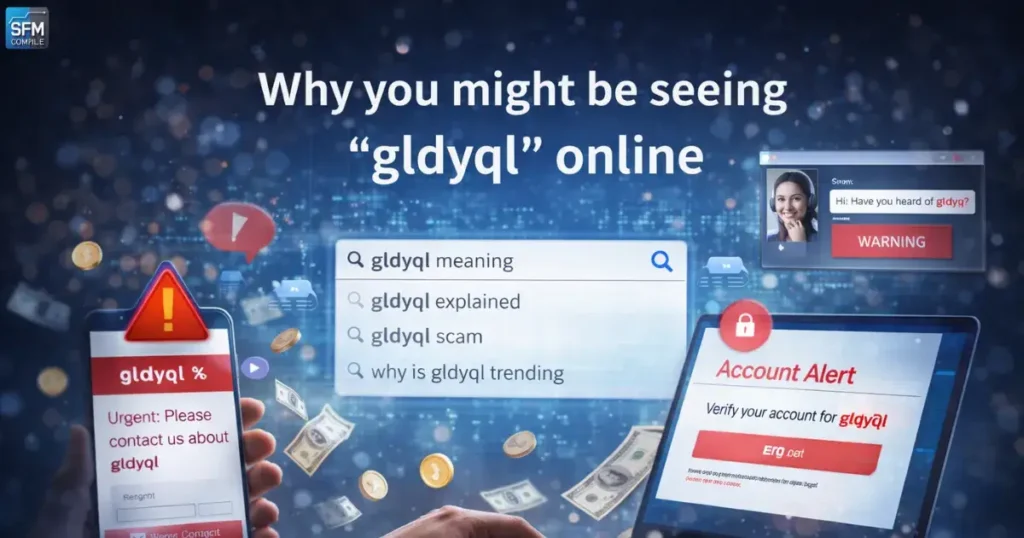
You usually don’t “discover” a term like gldyql in a dictionary. You see it in a specific context: a comment thread, a spam message, a browser autofill, a weird notification, or a search suggestion. The context is the clue. Without it, the keyword is just letters. With it, you can narrow down the most likely category.
It can come from search suggestions and copy-paste culture
Search engines and social platforms learn from what people type, even when it’s accidental. If one person shares a screenshot or a copied block of text containing gldyql, others may repeat it. That repetition can trigger autocomplete suggestions. The result is a weird loop: people search because it’s suggested, and it’s suggested because people search.
It may appear in app logs, filenames, or URL fragments
Apps and websites generate short strings constantly: cache keys, session labels, analytic identifiers, and feature flags. When those leak into visible places like error messages, file names, or copied text, they look like “secret codes.” In reality, they’re often routine internals that were never meant to be human-readable.
It can be attached to spam, scams, or fake “alerts”
Some scammers use odd strings on purpose because they bypass filters or look “technical.” Others include random characters to make messages appear unique and avoid detection. Online safety teams warn that scam content evolves quickly, and filtering often relies on spotting repeated patterns, which is why attackers add noise.
How to investigate “gldyql” safely and get closer to the truth
If gldyql appeared somewhere that made you curious or uneasy, don’t start by clicking random results. Start by collecting context. Where did you see it, what was on the page, and what happened right before it appeared? This approach works whether the term is harmless, meaningless, or connected to something risky.
Start with the surrounding context, not the keyword
The best “meaning” is often one step to the left or right of the word. Look for nearby words, the app name, the account that posted it, or the action that triggered it. If gldyql appears in a notification, check which app generated the notification. If it appears in a message, check the sender history and whether the wording matches known spam patterns.
Use a simple checklist before you interact with anything
Here’s a safe way to investigate without feeding scams or misinformation:
- Screenshot or copy the full context (not just the keyword)
- Check if it appeared inside a trusted app or a random webpage
- Search the whole phrase you saw, not only “gldyql”
- Look for consistent explanations across reputable sources
- Avoid downloading files, installing apps, or entering credentials
Validate credibility instead of chasing the first “definition”
If you find sites claiming a confident definition, treat that as a red flag by default. Many low-quality pages manufacture meanings to capture traffic. Prefer sources that show evidence: where the term appears, what platform it’s tied to, and whether multiple independent references match. If no credible pattern appears, the most honest answer may be that it has no established meaning yet.
Is “gldyql” a scam, a risk, or just harmless noise?
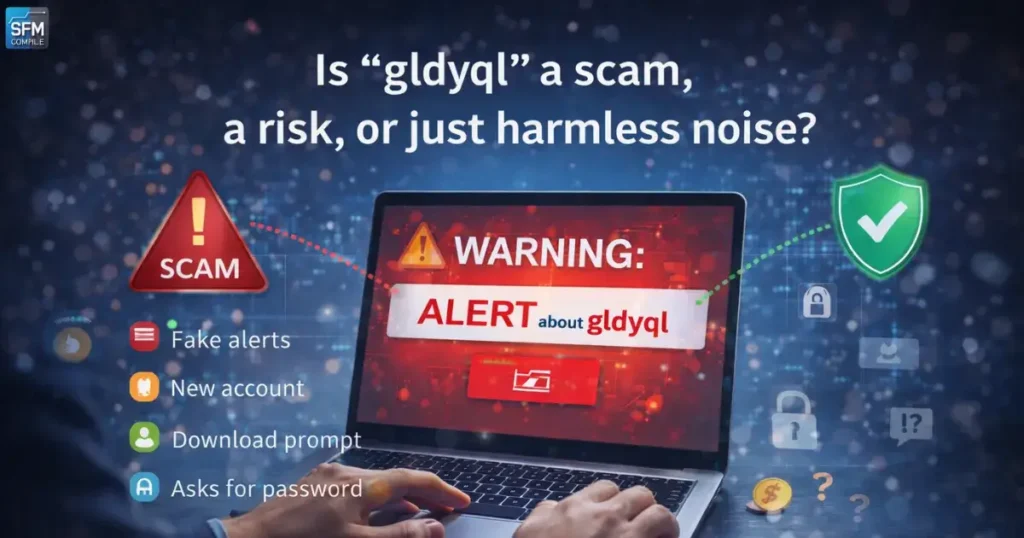
Most strange strings are harmless. But if gldyql appeared in a suspicious message, a pop-up, or a “security alert,” you should assume risk until proven otherwise. Attackers don’t need a word to have a meaning. They only need it to make you act, especially if it pushes urgency or curiosity.
Red flags that suggest you should stop and verify
If gldyql shows up alongside any of these, treat it as suspicious:
- “Your account is locked” or “verify now” pressure
- Requests for passwords, codes, or payment details
- Download prompts for “security tools” or “cleaners”
- Fake customer support numbers or urgent warning banners
- Messages from brand-new accounts with copied wording
What safe platforms do to fight scam content
Large platforms invest heavily in scam detection, but no system is perfect. Google, for example, describes using automated systems to detect and block large volumes of scammy results and reduce exposure to harmful pages. That’s helpful, but it’s still not a guarantee, which is why your own caution matters.
What to do if you already clicked something tied to it
If you clicked a result or opened a page connected to gldyql, don’t panic. Close the tab, avoid entering any information, and check your browser downloads. If a file was downloaded, don’t open it. If you entered credentials, change the password immediately and enable two-factor authentication where possible.
Why “gldyql” matters even if it’s meaningless
A random keyword can still have impact. It can waste time, distort search results, and become a vehicle for low-quality content or scams. It can also become a real “entity” online through repetition alone. Once enough pages and posts mention it, the internet starts treating it as something that deserves an explanation.
It’s a real example of how internet “meaning” gets manufactured
Many terms become “real” because people keep asking about them, not because they started with a clear definition. That creates opportunity for misinformation. Anyone can publish a confident explanation, and the most repeated story can outrank the most accurate one. Understanding that process helps you stay skeptical and avoid being pulled by hype.
It highlights how attention can be exploited
Odd strings trigger curiosity. Curiosity drives clicks. Clicks can be monetized through ads, affiliate funnels, or scam flows. Some Anti-Scam Groups publish research and awareness campaigns because scam tactics are widespread and costly, and the social engineering angle often matters more than the technical trick.
It can become a brand, community tag, or inside joke
Not every mystery keyword is negative. Sometimes it becomes a meme, a community tag, or a niche brand name. If people adopt gldyql as a label, the “meaning” becomes whatever that group consistently uses it for. The key is consistency: the more stable the context, the more real the meaning becomes.
If you’re using “gldyql” as a keyword or brand, make it clear and searchable
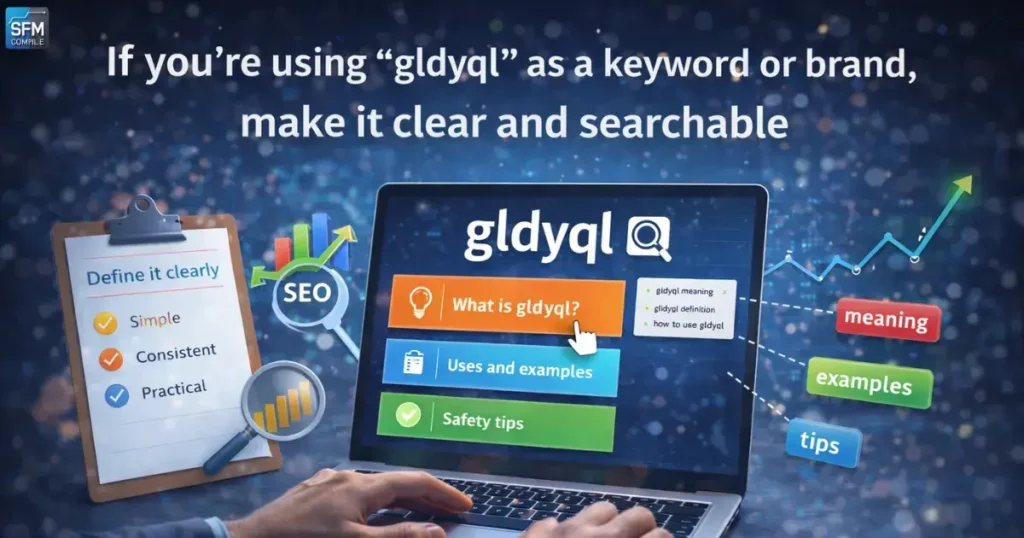
If your goal is to publish content around gldyql, you can shape what it becomes. That’s a big advantage: instead of chasing a definition, you can define it. But you need to do it in a way that search engines and readers can understand, or the term will stay confusing and attract the wrong traffic.
Define it in plain language and repeat the same framing
Pick one clear definition or positioning and stick to it. If gldyql is a concept, explain it in one sentence early. If it’s a project name, say what it does. If it’s a category, list what belongs in it. Consistency across headings, intro lines, and summaries helps readers and algorithms connect your pages into a coherent topic.
Build supporting context around the keyword
A made-up keyword needs supporting signals. Use related phrases naturally: “meaning,” “origin,” “uses,” “safety,” “examples,” and “how to verify.” Give real scenarios. Provide do’s and don’ts. The goal is to make your page useful even for someone who never heard the term before, because that’s your most likely visitor.
Avoid claims you can’t verify and focus on practical value
Don’t pretend there’s an official origin if there isn’t one. Instead, be transparent: “Here are the most likely possibilities and how to check.” That honesty builds trust and reduces bounce rates. It also prevents your content from aging badly if the internet later assigns a different meaning to gldyql.
Key points
| Topic | What to remember | Quick action |
| What gldyql is | Likely a string, typo, identifier, or new coined term | Look for context where it appeared |
| Why it shows up | Autocomplete loops, app-generated tokens, or intentional bait | Search the full phrase, not just the keyword |
| Safety | Could be attached to spam or scam flows | Don’t download, don’t enter credentials |
| Investigation | Context beats guessing | Screenshot, verify sources, compare patterns |
| Why it matters | Meaning can be manufactured through repetition | Stay skeptical and prioritize evidence |
| Using it as a keyword | You can define it through consistent content | Write a clear definition and repeat it |
Conclusion
gldyql may not have a single official meaning, and that’s exactly why it’s worth handling carefully. In digital spaces, unusual keywords can be harmless identifiers, simple typos, or intentional attention traps. The safest approach is to stop chasing quick definitions and instead focus on the context, the source, and what the term is trying to make you do.
If you’re publishing about gldyql, you have a chance to turn confusion into clarity. Define it in plain language, offer realistic possibilities, and give readers a safe checklist they can use immediately. Whether gldyql becomes a trend, a niche label, or fades away, practical guidance will keep your content useful and trustworthy.
FAQs about “Gldyql ”
Does “gldyql” have an official meaning?
Right now, gldyql doesn’t appear to have a widely accepted, authoritative definition. It’s more likely a generated string, a typo, a username, or a label people are experimenting with. The best way to interpret it is to track where you saw it and what was happening around it, then verify patterns across reliable sources.
Why are people searching “gldyql” so much?
Search interest can rise even when a term is unclear. Autocomplete suggestions, copied screenshots, bot posts, and curiosity-driven sharing can create a loop that boosts visibility. Once a few people ask “what does it mean,” more content gets published, and that makes the keyword look even more important, even if it started randomly.
Is “gldyql” connected to scams or hacking?
Not automatically. A random string alone doesn’t prove danger. But if gldyql appears in a suspicious message, fake alert, or download prompt, treat it as a possible scam signal. The risk usually comes from the surrounding message and the action it wants from you, not from the letters themselves.
What’s the safest way to check what “gldyql” is?
Start with context. Note the app, page, or message where it appeared, and search the full phrase you saw. Avoid clicking unknown downloads or entering credentials on pages pushed by pop-ups. If multiple reputable sources don’t agree on what it is, assume it’s not established and focus on protecting your accounts and device.
Can I use “gldyql” as a brand or keyword for my content?
Yes, and it can work well because it’s unique. The key is to define it clearly and consistently so readers understand it fast. Treat it like a new concept: give a simple meaning, real examples, and practical use cases. Avoid making claims you can’t prove, and your content will stay credible even as the term evolves.

I’m Eric Nelson, a professional content writer with over 8 years of experience creating clear, engaging, and well-researched content across multiple digital spaces. I focus on turning complex topics into easy-to-understand stories that inform, entertain, and add real value for readers.
My Experience & Expertise 🚀
Multi-Niche Content Specialist:
Over the years, I’ve written across a wide range of categories including tech, crypto, business, lifestyle, fashion, grooming, celebrities, and breaking news. I specialize in content that feels current, trustworthy, and genuinely useful. 💡
Writer, Researcher & Trend Analyst ✍️
As an author at SFMCompilee.com, I cover:
Tech insights & explainers 💻
Crypto & business trends 📊
Lifestyle, fashion & grooming guides 👔
Celebrity stories & trending topics 🌟
In-depth reviews and practical guides 🧭
I write with a balance of research, experience, and reader-first thinking, making sure every piece is informative, engaging, and easy to follow without unnecessary fluff.






One Comment